![]() |
| House Altar depicting Akhenaten, Nefertiti and Three of their Daughters, c.1350 BCE |
![]() |
| House Altar depicting Akhenaten, Nefertiti and Three of their Daughters, c.1350 BCE |
In the earliest stages of development Christian art drew heavily from pagan prototypes. Christianity had not yet been adopted by the Roman people, and they had to be secretive, or face persecution. Christian dogma also limited works of art by not allowing graven images to be created. It has been difficult for historians to differentiate early Christian art from Roman art before the year 100. Constantine would change all of that by adopting Christianity as the official religion of Rome, but until then Christians had to be secretive and careful. (1)
The image above is an Ancient Greek sculpture known as the Moschoforos or Calf bearer. This statue is attributed to the Greek sculptor Phaidimos.It is thought that the statue is of a young wrestler named Rhombos. He is carrying a calf to the sacrificial altar of Athena Pallas. Does this imagery look familiar? (2)
No higher resolution available.
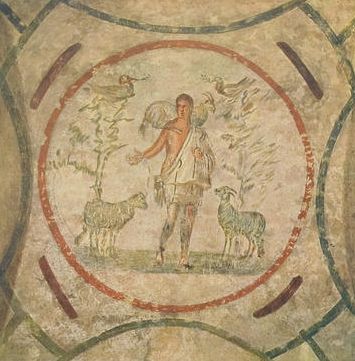
Good_Shepherd_Catacomb_of_Priscilla.jpg
The next image is of a fresco that was found in the Catacombs of Priscilla, Rome. As you can see,in this early Christian piece, the iconography is almost identical to the statue found in Ancient Greece. The main difference in these two artworks is that the calf in the former has been substituted for a ram in the latter. Similarly, both the males appear young and fit. Neither of the individuals are dressed elaborately. There is a quality of humbleness and simplicity to both works. The symbol of Christ as a shepherd is well known to us, but this is not a new theme. (3)
The Christian image found in the catacombs is indicative of what we find of Christian art during this time period. Remember, graven images are frowned upon by the believers. What little artworks identified are often hidden away, and is heavily influenced by the Greco Roman art. It seems that the early Christians found a way around their edict of no graven images all while blending in with the rest of the populous.
Notes
Art History, "A Ancient Christian Art," accessed September18, 2020, http://www.arthistory.net/christian-art/
Wikipedia, "Kriophoros," accessed September 18, 2020, https://en.wikipedia.org/wiki/Kriophoros
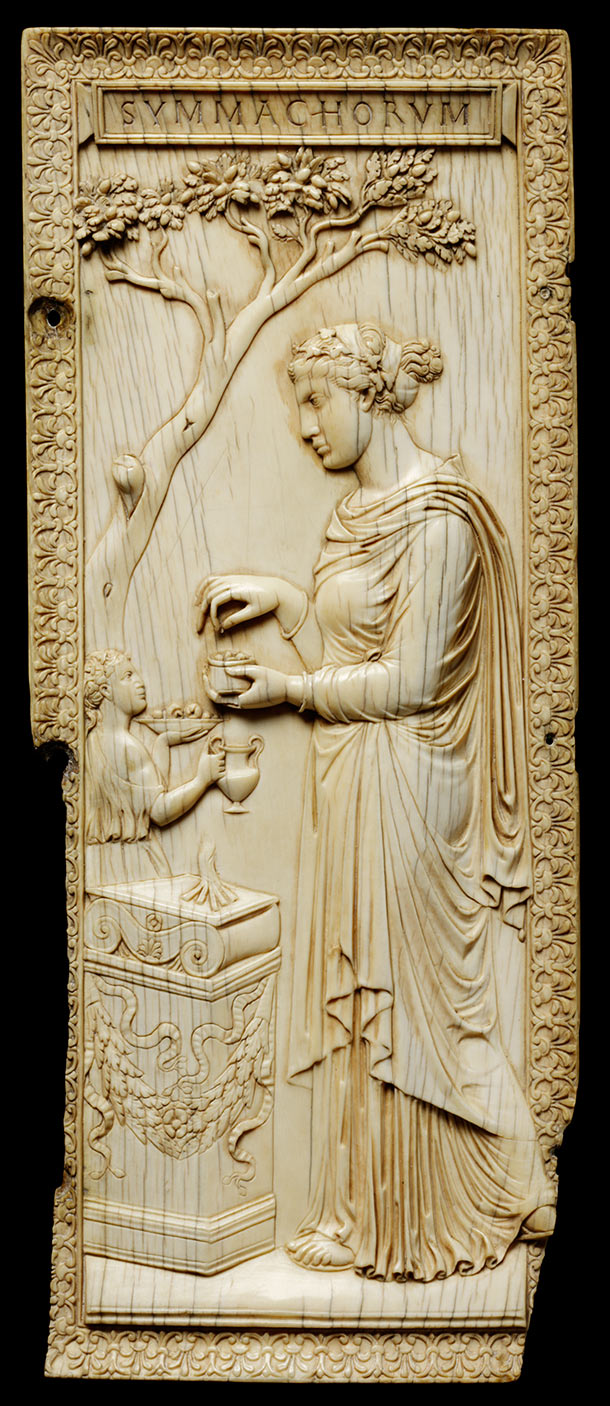
The Symmachi Panel, unknown maker, Rome, Italy, about 400 AD, carved elephant ivory. Museum no.212-1865, © Victoria and Albert Museum, London
With the ushering in of the Christian Era paganism is waning, but some of the populace still holds true to the old ways. This diptych is an engraving of a pagan scene relating to the cults of Bacchus and Jupiter. It was likely made in dedication to the conjoining of two aristocratic families either in marriage or priestess hood. Whatever the reason there seemed to be a revival of Neo-classic ivory carvings near the end of the 4th century just when paganism was outlawed.(1)
This one foot tall ivory relief is only one half of a diptych made between 393 to 394 AD. A diptych is a two paneled piece that folds together with the carvings facing out. There would be a small recess in between the panels so that wax could be poured inside to enable a person to carve out letters, poetry, or messages. This half is called the Symmachi tablet due to the inscription at the top and named for the family. The other half of the diptych is the Nichomachi tablet, but due to its poor condition we will only focus on the Symmachi half. (1)
In the panel we see a priestess standing before an altar. She has ivy, the plant of Bacchus, in her hair, and she is standing under an oak tree, a symbol of Jupiter. She is sprinkling incense onto a fire in front of a boy holding a cup of fruit and a jar of wine. It is thought to have been an adaptation or copy of a Greek relief. (2)
There is some argument over what occasion, if any, the panels represent. Marriage, priestesshood, or a functioning codex are some theories. What we do know is that the piece is reminiscent of the Greek style of relief sculpture. The individuals are sculpted in profile and the drapery is incredibly detailed. The weight is born on a single leg in Greek contrapposto style. It is a throwback to earlier art. Could this be a rebellion against the new monotheistic religion? Maybe this piece was a codex used to send secret messages between the families who were both senatorial. It is likely that some of the populous would have fought to keep their traditions, and the aristocratic citizens would have had the most to lose. (1)
Notes
1. Unknown, Feminae: Medieval Women and Gender Index, accessed September 16, 2020, https://inpress.lib.uiowa.edu/feminae/DetailsPage.aspx?Feminae_ID=37594
2. The Symmachi Panel, about 400 AD, Victoria and Albert Museum, accessed September 16, 2020, www.vam.ac.uk/content/articles/t/the-symmachi-panel/

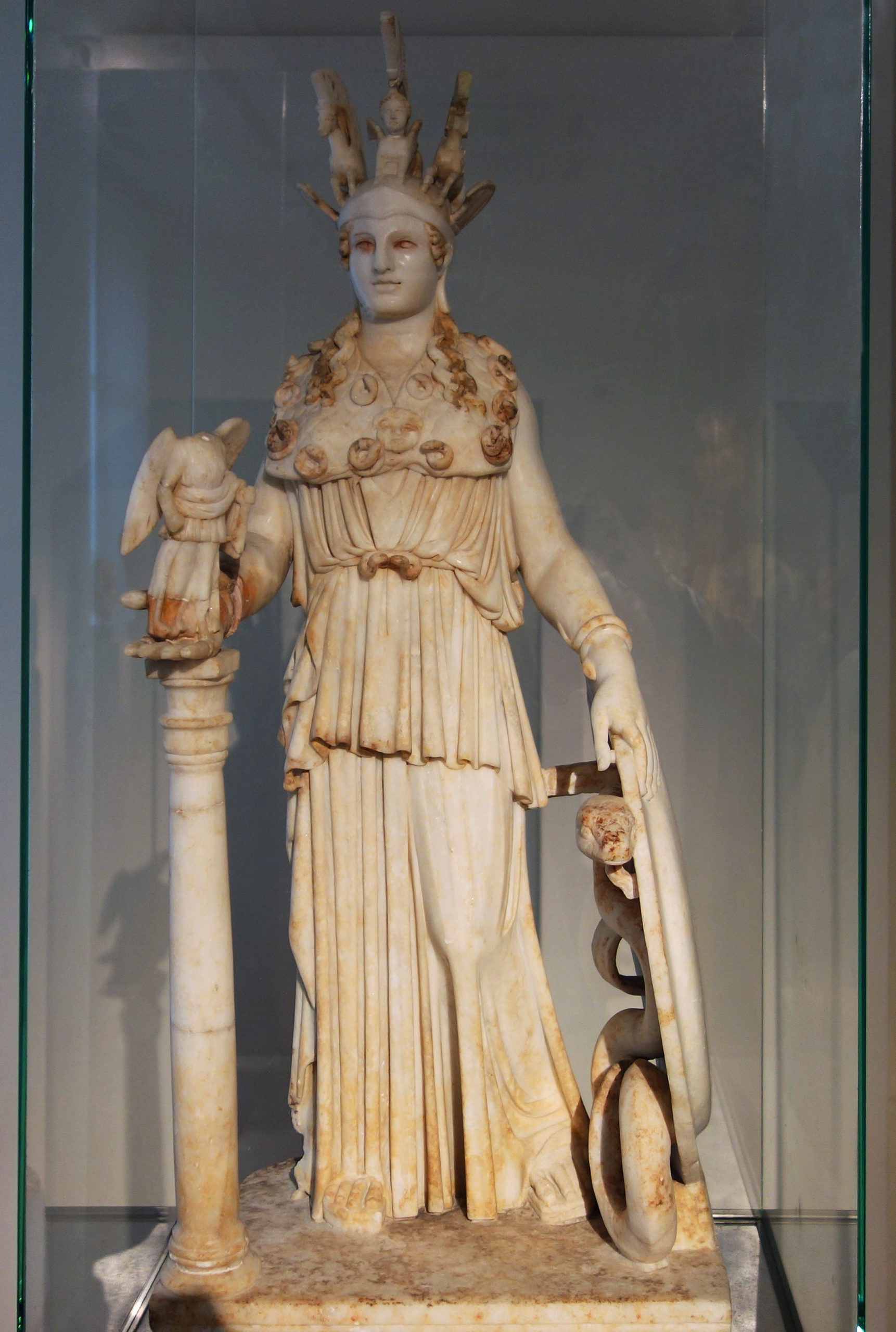
Pheidias, Athena Parthenos, 447–32 B.C.E. (this is a 3rd c. C.E. copy known as Varvakeion found in Athens), National Archaeological Museum in Athens; photo: Steven Zucker, CC BY-NC-SA 2.0)
Greek society was centered around a polytheistic religion in which each deity represented a certain facet of the human condition. The gods/goddesses had the ability to influence human affairs and often they were deemed patrons of a city. Early on the Greeks built simple altars for the gods/goddesses, but over time massive temples came into fashion. Inside these temples statues of the deity's likenesses would be placed. This lovely statue of Athena, the goddess of wisdom, is one such example. (1)
Athena Parthenos is a replica of the lost chryselephantine (gold and ivory) sculpture that stood 38 feet tall. It was made by the acclaimed sculptor Phidias and his assistants and was housed in The Parthenon on the Acropolis of Athens. The sculpture shows Athena resting after winning a battle. In her right hand she holds Nike, the goddess of victory. In her left hand she supports a carved shield depicting a battle with the Amazons with a large serpent on the back side. On her breast there is a relief of the head of Medusa. Her helmet bears two griffins with the Sphinx in the center. Her long tunic is cinched together by two intertwined serpents, and her weight is shifted so that her right side is bearing it while her left knee is relaxed and bent. It is believed that she had a spear that was resting against her right arm. Her neck piece was also of serpents and a gift from her father Zeus. (2)
This colossal statue of Athena was a marvel of the time. Phidias began sculpting her in 447 B.C.E. and it took nearly 10 years for the finished product to be dedicated to the city. It is said that the entire treasury of Athens was wrapped up in this work, and it is within the well known structure of The Parthenon that the likeness resided. In fact, it is believed that the Parthenon was actually built with her gigantic dimensions in mind. She stood on a pedestal measuring approximately 13.5 by 26.4 feet surrounded by Doric columns facing the east door. She watched over Athens for nearly a thousand years until, it is believed, she was either taken and destroyed by Constantinople or stolen. (3)
Imagine trotting into Athens on your horse. You look up to see this gleaming colossal statue draped in gold and ivory looking over the city. She's 38 feet tall standing atop a pedestal that adds another 13 to 25 feet to the intimidating illusion. She's housed inside a structure just as big, and covered in symbology of strength and victory. It's likely to have given pause to the most barbaric of travelers. It would have been a wonderful sight to behold.
Notes
1. Mark Cartwright, "Ancient Greek Religion" in A Ancient History Encyclopedia, https://www.ancient.eu/Greek_Religion/, accessed September 11, 2020
2. Wikipedia, s.v. "Athena Parthenos," last modified September 7, 2020, https://en.m.wikipedia.org/wiki/Athena_Parthenos, accessed September 11, 2020
3. Mark Cartwright, "Athena Parthenos by Phidias" in A Ancient History Encyclopedia, https://www.ancient.eu/article/785/athena-parthenos-by-phidias/, accessed September 11, 2020.
Unknown
Attic Black-Figure Column Krater, 525–500 B.C., Terracotta
33 × 35.5 × 30 cm (13 × 14 × 11 13/16 in.), 96.AE.303
The J. Paul Getty Museum, Villa Collection, Malibu, California, Gift of Barbara and Lawrence Fleischman
We have a lot of examples of Ancient Greek pottery due to the durability of terracotta or fired clay. I chose this example not only because of the story it tells, but also because it gives us a unique insight into the lives of the Ancient Greeks.
The Greeks were known to make a very thick sweet wine that had to be mixed with water. This vessel, known as a Krater, was created between 525 and 500 B.C, and would have been used to do both the mixing and ladling of the wine during the male gatherings known as symposiums. You can see that the mouth of the vessel is very wide as is the neck which allowed for both the filling and ladling of the liquid. There are two handles attached to either side for ease of carrying. It has a wide body that tapers down rather abruptly, and there is a simple foot attached to the bottom for balance.(1)
The slip painting technique is known as the black-figure style. It was a Corinthian technique that was adopted by the Athenians around 630 B.C.E. The combination of painting with black slip inset on a lighter panel of slip, incising details with tools, and the 3 stage firing process is what gives us this unique aesthetic. The firing was a complicated process that would have taken a knowledgeable master. It is the firing that brings the black silhouettes to life through the venting process which oxidizes the chemicals in the clay.(2)
On the body of the Krater is a motif or slip painting of the hero Odysseus escaping the Cyclops Polyphemus. Odysseus tied himself to the belly of a ram after getting the cyclops drunk on straight wine and piercing out his eye. We know that the mixing of water with wine was a Greek statement of civilized behavior and can conclude that the artist was possibly making a double entendre by putting this motif on a Krater. It is the stories that we find on ancient artifacts that give us a glimpse into the mentality of the civilization. Often, with the ancient Greeks, we find tales of heroic deeds and mythological monsters.(1)
In conclusion, we can discover many things about a civilization through their artworks. For example, knowing the utility of an artifact helps us understand a little bit about the societal exchange taking place. Techniques borrowed from other geographical locations tell us a little bit about the cultural sharing in this period. Finally, when we decipher the stories we can begin to understand how the people related to the environment, each other, and what their religious beliefs and customs may have been.
Notes
“Unknown, Mixing Vessel with Odysseus Escaping from the Cyclop’s Cave, 550-500 B.C.E", (video) Khan Academy. Accessed September 9, 2020. https://youtu.be/BDo3L3vqE6M.2.
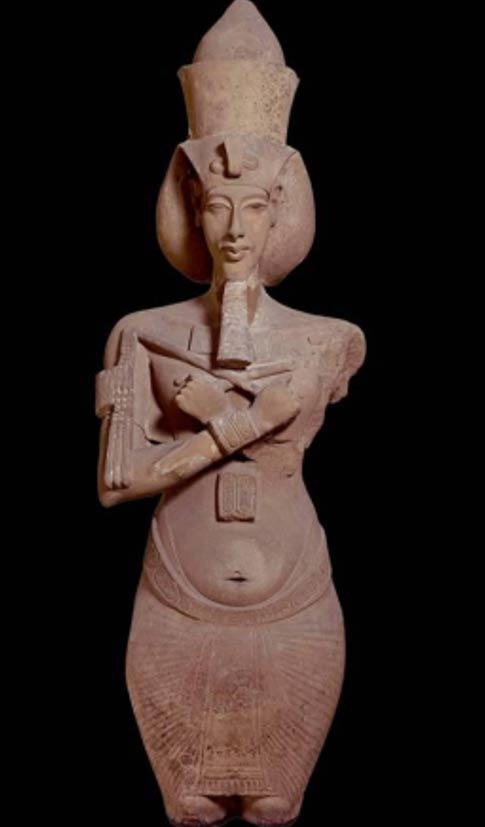
Figure 2. Unknown. Akhenaten, 18th Dynasty, ca. 1353-1335 BCE. From the temple of Aton, Karnak, Egypt, Sandstone. http://www.ancient-origins.net/ancient-places-africa/art-amarna-akhenaten-and-his-life-under-sun-002587
Akhenaten, Egypts tenth ruler of the eighteenth dynasty. One of the most fascinating figures in all of Ancient Egypt. In fact, we knew nothing of him until the nineteenth century. It is widely believed by scholars that Akhenaten’s successors tried to wipe him from the history books. Akhenaten’s entire existence is shrouded in mystery and scandal, but the most interesting thing about the entire enterprise is the dramatically different style of art that comes about during his rule.(1)
The Colossal Statue of Akhenaten standing at 41ft is a sculpture of exaggerated proportions and distorted features in sandstone. His face is elongated with effeminate features. The lips are thick and full and accompanied by large dimples. The nose is long and thin and the eyes are perfectly almond shaped. The neck is stretched and the body has no muscle definition. His stomach protrudes out and down encapsulated by curvy hips. He may be dressed and holding relics like a Pharoah, but that is where the similarities end. Akhenaten’s depiction in this statue is way more natural than we have ever seen from a Pharaoh. It’s definitely a romanticized version of natural, but natural nonetheless. There is nothing masculine, heroic, or imposing in this figure like you would expect from a Pharaoh.
All of Ancient Egyptian art was highly stylized to show the strength and power of the ruler. So why would Akhenaten purposely have a statue made of himself that is exaggerated almost to the point of appearing feminine? One theory is that he didn’t, but rather his successor, had work done on the artifacts in an effort to obliterate any memory of Akhenaten. Another theory is that when Akhenaten began the monotheistic worship he wanted to appear otherworldly and God-like. The distortions made by the artist would have separated the Pharaoh from the common people in such a way that stood apart even from the elder Pharaohs. Yet another theory speculates that Akhenaten may have actually had a genetic disorder or even possibly that he was hermaphroditic.(2)
What if the purpose was just the opposite of trying to look heroic and kingly? What if Akhenaten wanted to appear more natural to his people? What if he knew that appearing effeminate would make him a more relatable and beloved to the people? Whatever the case may be, we have a break in the monotony of Ancient Egyptian art with the appearance of the Pharaoh Akhenaten. We have a lovely realistic king who appears romantic and beautiful.
Cyril, Aldred. Akhenaten: King of Egypt. London: Thames and Hudson, 1988

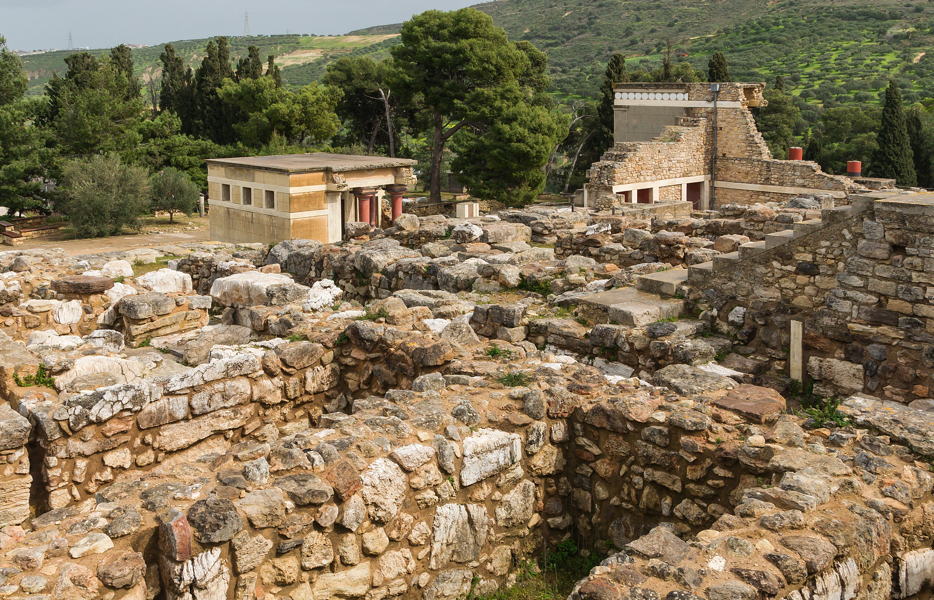
The archaeological site at Knossos, with restored rooms in the background, Crete (photo: Jebulon, public domain)(1)
Archeologist have a responsibility to the preservation of the past. When working on an excavation they must take special care in recording the artifacts so as not to cause further harm. They must also make sure that they share the findings with the public, and one of the ways in which they do this is by restoration. The restoration process can help the public envision what the site may have looked like before it fell into ruins. The problem with this method is that it can cause irreparable damage to the site as well as mislead the public into believing that they are seeing something authentic when it's really an artists conjecture.
What you see above is an example of archeological restoration used to garner interest in what would otherwise be a rather uninspiring place. It is a very popular tourist attraction that probably would be less of a draw if it were just a pile of rocks. It has been turned into a sort of interactive experience where a person can walk through the palace and enjoy the colorful wall paintings or hang out in the spaces meant for kings and queens. By its very nature restoration can be a very valuable educational tool. (2)
Restoration can help preserve artifacts. In fact, it is believed, that without restoration parts of this palace would have fallen into ruin. Would you rather have a lost artifact or one that may not be entirely historically accurate? While it is true that restoration can be misleading it does, however, play an important role in interpreting the past. The artist has the leisure to research and restore the site based on what we know of other archeological sites. He/she can make informed decisions on what is appropriate to add or subtract. (3)
Deciding on whether or not to use restoration on an archeological site may be a difficult choice, but as technology grows we should be able to find a middle ground. It seems that 3D models can serve the same purpose as restoring something as complex as the throne room, and if we can do a 3D model then surely we could add in some virtual reality. There is no simple answer to this complex dilemma of when to use restoration. We just have to trust that one day we will have the technology to make the decision a bit easier.
Notes
1. https://smarthistory.org/ancient-mediterranean/the-palace-at-knossos-crete/
2. Lipe, William D, "Archeological Ethics and Law," in Crow Canyon Archaeological Center, June 5, 2019, accessed September 2, 2020.
3. Dr. Senta German, "The Palace at Knossos (Crete), " in Smarthistory, July 11 2018, accessed September 2 2020, https://smarthistory.org/ancient-mediterranean/the-palace-at-knossos-crete/
Artist Jackson Pollock dribbling sand on painting while working in his studio - Photo by Martha Holmes image source ...