Sunday, April 4, 2021

Pollock's Passion


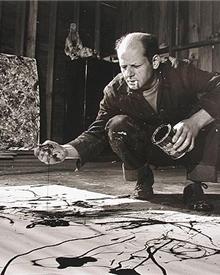
Artist Jackson Pollock dribbling sand on painting while working in his studio - Photo by Martha Holmes image source


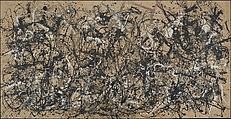
Jackson Pollock, Autumn Rhythm (Number 30), 1950, Enamel on canvas, 8ft 9in x 17ft 3in image source


Defining non representational art can become a tedious and tricky enterprise, but fundamentally it should be understood as art that doesn’t represent a being, place, or thing. It shouldn’t be confused with abstract art which is the distortion of a subject whether it be a figure, landscape, or still life (being, place, or thing). The meaning of nonrepresentational art is entirely subjective to the viewer and lends a sense of freedom to both the artist and viewer. (1)

Nonrepresentational art usually contains so much energy that we are forced to pay attention. Whether the artist is working in gestures or simple shapes, lines, and colors, emotions can be felt. We study the relationship of shapes and form in design because simple shapes can make us feel certain emotions. Graphic designers, for example, utilize this energy to create simplified designs that can communicate product intent. The artists working in the Abstract Expressionist movement knew how to manipulate their materials to evoke emotions in their viewers without the use of a formal subject. 

Theoretically emotions can be conveyed through simple line, shape, and color, but the type of emotions felt are rooted in personal experience and culture. It would be remiss for an artist to assume that a person in Indonesia might have the same reaction to the color white as someone from the US. However a designer could assume that white might represent mourning for an Indonesian and purity for an American. The same can be said for line and shape.

The artists of the New York school, also known as Abstract Expressionists, like Jackson Pollock (above), believed that the purpose of their art was to communicate primal truths about the human condition. It was a response to a world turned upside down by war and economic collapse. They were influenced by new philosophies from Carl Jung’s primitive archetype theories to Existentialism. Existentialism was especially appealing to this school of art due to the position that an individual's actions give meaning to life. (2)

Pollock was a New York artist who was involved with the Abstract Expressionists movement during the 1940’s and 50s. Despite the name, these artists were intentionally rejecting representational forms. Their motive was to communicate the artist’s inner state through gestures and color. Pollock had developed a technique of dripping paint onto a canvas. He would use various instruments to spray the canvas including brushes and turkey basters. He was considered a gestural artist who tried to communicate emotions through action. He was searching for a deeper truth in a post war world, rejecting the past, and creating his own language. The Autumn Rhythm painting is an example of his raw spontaneous emotion being applied to an unprimed canvas(3)

Whether or not the viewer finds value in nonrepresentational art, it is impossible not to feel something when viewing it. The sheer size of the Pollock canvas is enough to evoke a reaction, but the gesture is pure energy. What type of energy you experience is entirely subjective, giving the freedom to explore the work not only with the eyes but with the soul. In Pollock's case, the gesture speaks. It is up to the viewer to decide what is being revealed.

Sources
  1. Gersh-Nesic, Beth. "What Is Nonrepresentational Art?" ThoughtCo., accessed April 4, 2021 https://www.thoughtco.com/nonrepresentational-art-definition-183223
  2. Oxford University Press, "The     Impact of Abstract Expressionism," in Smarthistory, August 9, 2015, accessed April 4, 2021, https://smarthistory.org/the-impact-of-abstract-expressionism/.
  3. Dr. Virginia B. Spivey, "Abstract Expressionism, an introduction," in Smarthistory, August 9, 2015, accessed April 4, 2021, https://smarthistory.org/abstract-expressionism-an-introduction/.

Sunday, March 21, 2021

Savage Salvation


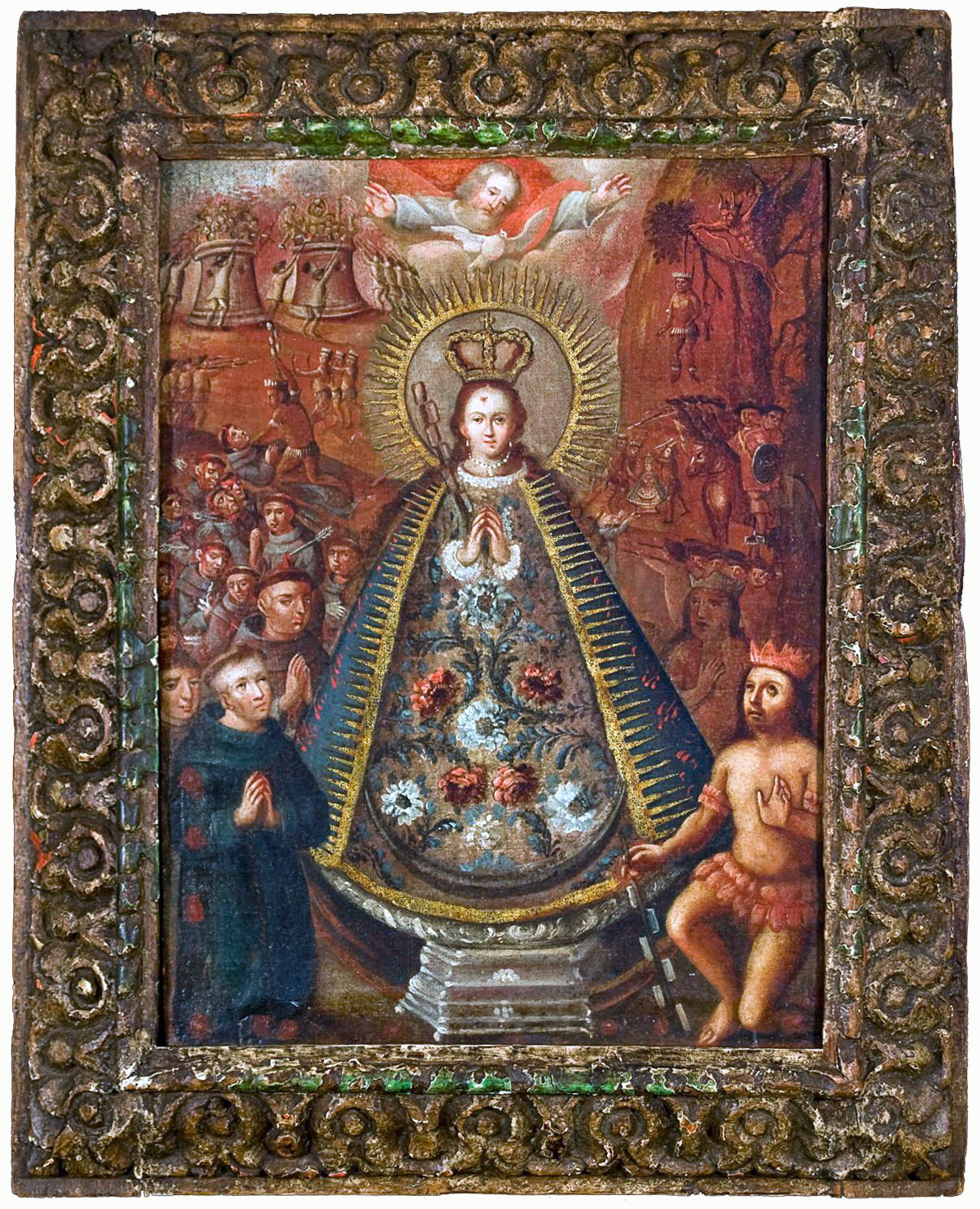
The Virgin of the Macana, second half of the 18th century, oil on canvas (History Collections New Mexico History Museum) image source

The painting of the Virgin of Macana, seen above, is an illustration of the Pueblo Revolt of 1680. It was  a version of history as seen from the Franciscan perspective to inspire future missionaries. This painting, and others like it, were used to justify the atrocities inflicted upon the indigenous peoples during the European pursuit of colonization. The Franciscans viewed Mary as their protector and defender who oversaw their missions. God would have approved of the conversions which is illustrated above with God looking down and smiling upon those who are kneeling and praying to the Virgin Mary. 

The artist who painted this picture was most likely referencing the text, Teatro mexicano (1698), written by Franciscan Friar Agustin de Vetancurt as the main source for the battle. The text contained historical accounts of the uprising as told by Spanish soldiers as well as accounts from funeral orations honoring the Franciscans who were felled during the uprising. There is no mention of accounts given by the Pueblo people so we must assume that it was a lopsided historical viewpoint.

The central figure is that of the Virgin Mary as a statue with a wound in her forehead holding a macana, a wooden weapon that was used by the Nahua peoples of Central Mexico. The wound in her forehead represents the uprising and violence done to the statue during the revolt. The attempt to destroy the statue left a mark on it to be remembered as miraculous in the future.   On her left a Franciscan monk, and to the right, a Puebloan leaning on a macana. These two figures represent the two groups who were at odds with one another. The presence of the macana, which was not a weapon of the ancestral Puelboans, indicates a lack of care given to the detail of the Pueblo nation. Within the battle scene we have two types of Puebloans. In the background we have the savages that are busy mutilating and engaging in battle while the foreground shows the pious subjugated type. There is even an image of a Puebloan being hanged by the devil in the right background. There’s a lot of chaos that God is looking down upon including a small scene of Puebloans attacking a statue of the Virgin Mary. The artist was using tropes or stereotypical representations, to indicate that the noncompliant indigenous people were either savages (mostly naked but for feathers, brutalizing others) or subjugates while the Spanish soldiers and Franciscan monks appear to be victims and martyrs (kneeling piously with praying hands while being attacked).

The Fransiscan Missionaries were sent to the Americas in order to convert the locals to the religion of Christianity. They were zealous Monks who believed they were saving the souls of the idolatrous savages. When Sante Fe was founded in 1607 it was the Franciscans who looked to the spiritual salvation of the local Puebloans. It was not uncommon for them to abuse the people in their quest. This, of course, escalated the tensions between the two groups and eventually we had the uprising, or Pueblo revolt of 1680. A century later the region had been firmly reconquered by the Spanish, but the Franciscans were still sending missionaries in order to convert and save the souls of the indigenous population. This painting and others like it were meant to inspire those that would devote their lives to these tasks.

Art can be a powerful tool when used to promote a narrative, and this artist appears to have painted the Spanish in a positive and pious light while depicting the Pueblo peoples as savages in need of salvation. It’s a visual defense of the eradication and prohibition of native customs in order to save souls from eternal damnation. The Virgin of the Macana is a reminder that the Franciscans believed that God wanted the natives to convert them. It is a lopsided story that lacks a voice, but hopefully, we can restore this bias through research and understanding. By looking at multiple viewpoints and revisiting historical accounts we can re-contextualizing these works of art.

Source

Dr. Emmanuel Ortega, "The Virgin of the Macana and the Pueblo Revolution of 1680," in Smarthistory, October 16, 2020, accessed March 20, 2021, https://smarthistory.org/virgin-macana/.

Sunday, February 28, 2021

Court of the Kongo Peoples

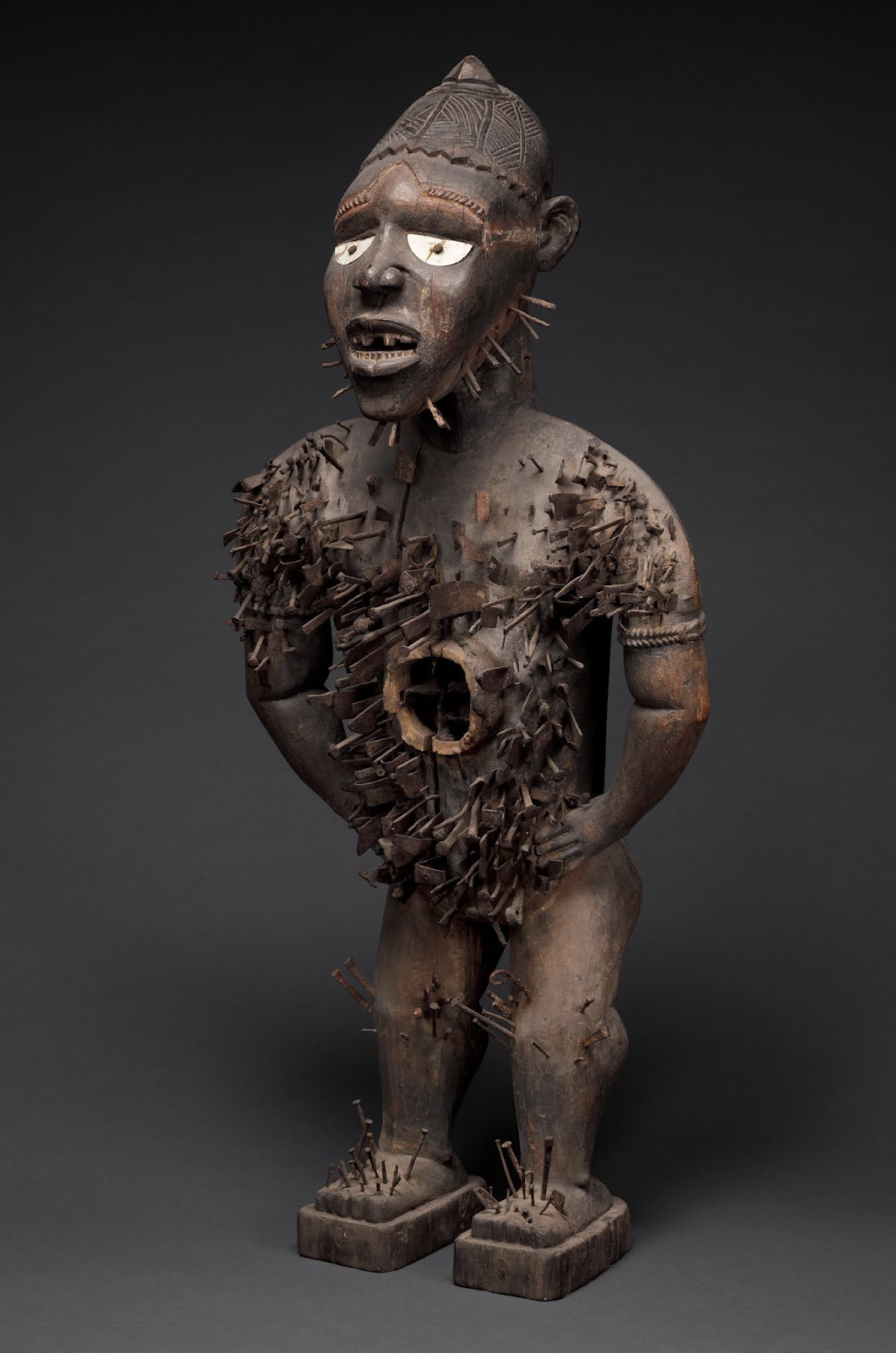
Kongo Peoples, Power Figure (Nkisi N’Kondi) c. 1850-1900, wood, paint, metal, resin, ceramic.(image source) 


Nkisi N’Kondi were Central African transformative power figures, or magical charms, used by spiritual specialists, or ngangas, to help solve disputes and bind agreements within the community. These objects acted as important mediators as well as criminal deterrents for their earthly counterparts.


The Nkisi N’Kondi was sometimes represented as an authority figure like a king or an enforcing lord, but it could be carved into an animal as well. The figure in the above image is posed in an aggressive posture with hands on the hips donning a headdress that was worn by chiefs and priests. The remnants of a beard are a rank design exhibiting seniority. These menacing and powerful attributes are what gave the figure its authority to conduct business. (1)


The figures’ head or stomach would have been filled with medicinal herbal ingredients called bilingo. The medicine was then encased with a reflective surface representative of the spiritual realm such as a mirror or piece of glass. The Kongo peoples believed that the herbs were sacred medicines brought to earth by the Great God, Ne Kongo. These herbs known as nkisi represented the spirits and could be called upon or awoken by supernatural forces wielded by the ngana, or priest. They are what empowered the figure with spiritual authority. Different medicinal combinations were used depending on the purpose whether it be benevolent or menacing.(2)


The ngana was a ritual specialist trained in conflict mediation of the body and spirit who oversaw the creation of the nkisi nkondi. Once carved the priest would endow it with power through the chosen nkisi. The ngana would have been the person called upon when an accusation was levied against someone. These disputes were known as mambu. The Ngana would then summon the spirit by driving sharp objects into the figure, activating the spirit within. The type of object used would have alerted the spirit to the severity of the crime. Nkondi refers to the figures’ ability to hunt and if a person was accused of theft for example, then the nkondi would hunt the person down and exact its punishment. The nkisi n’kondi was also used as a way to seal important agreements and punish future violators of the agreement. (3)


Because the nkisi n’kondi belonged to the ngana it would have undergone a significant transformation over time. The number and type of objects nailed into the figure would have been a testament to the priests ability to persuade the supernatural forces to intervene in earthly affairs. It would have been a visual deterrent to those who may be thinking of committing a crime or breaking an agreement. The figure above appears to have been used by a talented ngana due to the number of nails driven into it.  


Sources

  1.“Power Figure (Nkisi N’Kondi: Mangaaka)”, The Metropolitan Museum of Art, accessed February 27, 2021 https://www.metmuseum.org/art/collection/search/320053.
  2.Dr. Shawnya L. Harris and Dr. Peri Klemm, "Power Figure (Nkisi Nkondi), Kongo peoples," in Smarthistory, August 9, 2015, accessed February 27, 2021, https://smarthistory.org/nkisi-nkondi-kongo-people/.
  3.Victoria Hobbs, “The Function of a ‘Fetish’ Figure,” The Victoria and Albert Museum, accessed February 27, 2021, http://www.vam.ac.uk/content/journals/conservation-journal/issue-31/the-function-of-a-fetish-figure/.

Sunday, February 14, 2021

Huang and Tosa

Attributed to Tosa Mitsunobu, Bamboo in the Four Seasons, late 15th to early 16th century, ink, color and gold leaf on paper image source
detail, Huang Gongwang, Dwelling in the Fuchun Mountains, 1350, handscroll, ink on paper image source 


These two paintings, while speaking to the passage of time, exhibit different styles due to their locations, and the contexts in which they would have been viewed. Huang Gongwang's handscroll was a creative outlet meant for private contemplation while Tosa Mitsunobu's panels were meant to inspire the public.  Both artists are using popular local techniques to create the illusion of passing time. 

Chinese landscape painters, like Huang, were often Daoist looking to escape daily life by communing with nature. Mountains and water were important themes to the Daoists. They relied upon brushstrokes to give emotion to the painting. The above image, Dwelling in the Fuchun Mountain, is an example of an imaginary landscape that was painted and embellished over a long period of time. The painting was a 22 foot long handscroll. This means that the viewer would have been intimately looking upon the scroll bit by bit as the painting was unwound. There is no way that the viewer could have seen the painting in its entirety. The viewer would have been on a journey through time as he/she focused on the sections flowing through the hands.(1)


Japanese painters during the Muromachi period would have followed Shintoism or Buddhism and utilized the Yamato-e painting tradition which is a term that describes something that is Japanese.(2) The above image, Bamboo in the Four Seasons, is an example of this because the subject matter, the changing seasons, is considered to be a Japanese theme. Another example of Yamato-e was the use of bright thick pigments like what was used to paint the spring flowers and autumn ivy. A person standing in a room with the five and a half foot tall painting would have been able to see the entire work. The purpose of the painting was to inspire Renga, a form of collaborative poetry that was popular at the time, and would have been viewed while the poetry was being recited. It was originally a multi-paneled wall that may have opened up to a bamboo garden.(3)


Huang was in his late seventies living as a recluse when he began his masterpiece. He used many different brush styles and techniques denoting the different moods and atmospheres. Painting was a means to convey his inner self which was a popular concept with Chinese painters. He painted when inspired and captured the passage of time through the use of multiple perspectives and subtle changes in textures and spacing. It was a deeply intimate painting that was not meant for public consumption.(1) The Tosa painting also captured the passage of time but through less subtle methods. For example, we know the far right panel represents spring due to the presence of violets and shepherd’s purse flowers. As the viewer moves to the left, summer, autumn, and winter follow, each containing elements that would denote the season. The elements used were part of a poetic language called Kigo that were meant to enhance the Renga recital. It is important to note that while the use of the bamboo element was considered to be Chinese in nature, the transition of the seasons would have been Japanese.(3)


Japanese landscape painters, while influenced by the Chinese, were able to develop their own language. The passage of time may be experienced universally, but the illustration of the concept varies culturally. The different techniques used in Dwelling in the Fuchun Mountain and Bamboo in the Four Seasons highlight how two regions can offer distinct viewpoints of the same idea.


Sources


1.Yamato-e, Japanese Architecture and Art Net Users System, Jaanus, accessed February 12, 2021, http://www.aisf.or.jp/~jaanus/deta/y/yamatoe.htm.

2. Hung Sheng, “Huang Gongwang, “Dwelling in the Fuchun Mountains,” Smarthistory, November 28, 2015, accessed February 14, 2021, https://smarthistory.org/huang-gongwang-dwelling-in-the-fuchun-mountains/.

3. Dr. Sonia Coman and Dr. Steven Zucker, "Bamboo in the Four Seasons: painting and poetry in Japan," Smarthistory, March 16, 2018, accessed February 14, 2021, https://smarthistory.org/tosa-mistunobu.


Friday, January 29, 2021

the Davids (revised)


Michelangelo, David, 1501-1504, marble 517cm x199cm (Galleria dell’Accademia, Florence Italy)


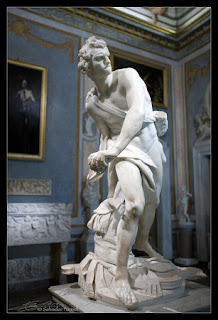
Gian Lorenzo Bernini, David, 1623-24, marble, 170 cm (Galleria Borghese, Rome) (photo: Salvador Fornell CC BY-NC-ND 2.0) 


In the images above we see the story of David told by two artists more than a hundred years between. While the message stays the same, the political landscape changes. What sets these two sculptures apart from one another is their ability to tell the story while speaking to the era in which they were made. Michelangelo follows the classical structure that was popular during the high renaissance while Bernini uses baroque formulas that emerged during his time.


Michelangelo was working as an artist during a time of classical revival. After his success with the Pieta sculpture, he was commissioned to carve the statue of David for the Cathedral of Florence. It was originally to be placed more than 40ft above street level onto one of the buttresses which is why it is so large. It, however, ended up being placed in the town square outside a government building because it was so heavy.  Michelangelo's statue encompassed the ideal form often seen in the elder Greek/Roman sculptures. His use of contrapposto spotlights David’s superhuman beauty where the viewer can see the idealized musculature. This statue is composed in a restful position where the energy is building, but has yet to achieve its climax. We are seeing a snapshot of the figure right before he sets to work on the enemy who may be perceived as the recently ousted ruling family of the Medici, or even the extremest priest, Savonarola. Savonarola preached against the “vanities” and tried reforming the church, but was eventually executed. Michelangelo's David became a symbol of strength for the city of Florence. (1)


Bernini was working during a time when artists were engaging the viewer in a more active way. He wanted the audience to feel the energy and emotions of the subject and he did this by sculpting a less ideal figure that the viewer could relate to. He also pulled the audience into the sculpture by using diagonal lines that would engage the viewer. During the high Renaissance, when Michelangelo was working, artists often used the pyramid structure to build their compositions. It was a strong foundation that reflected stability. The Baroque artists, like Bernini, deviated from this structure and began using diagonals to make the composition more active. The idea was that the more relatable the art became, then the more the church would be able to affirm and strengthen the beliefs of its populous. This was important during the baroque period because it was a tumultuous time for the church. Bernini’s sculpture of David is a successful example of Baroque era techniques in that the action is unavoidable and engaging. (2)


These two sculptures are a good representation of the evolving nature of the Catholic Church and its influence on the people. When Michelangelo was sculpting his version of David the Church was strong, influential, and easily defeated its challengers. It was something to look upon with awe and reverence, much as Michelangelo’s sculpture of David, but by the Baroque period that foundation was beginning to crack. The Protestants would not be going away and the Church had to learn to live with the split. It responded by utilizing the now popular baroque style to emotionally engage their audience in the biblical stories. This is important because the once stoically distant Church authority is now actively inviting the viewer in. Art can be a powerful emotional guide, and the Catholic Church used that to their advantage.


Sources
    1. Dr. Steven Zucker and Dr. Beth Harris, "Michelangelo, David," in Smarthistory, December 6, 2020,  accessed January 28, 2021, https://smarthistory.org/michelangelo-david/.

    2. Dr. Beth Harris and Dr. Steven Zucker, "Gian Lorenzo Bernini, David," in Smarthistory, July 12, 2015, accessed January 28, 2021, https://smarthistory.org/bernini-david-2/.

Tuesday, January 19, 2021

Spring 2021 Intro to Me


Hi! My name is Ashley and this is my Dog, Diesel. I though you would appreciate his likeness more than mine. If you see him, then I'm probably not too far behind. 

This is my junior year and my first semester as an official fine arts major. I will probably seek out a job in graphic design/marketing of some sort. I am normally a lover of live music, but the pandemic has altered my ability and willingness to seek out such activities. I also like to hike. Since adopting Diesel I haven't been able to do much hiking because he's overweight with aggression problems, but we're working on it. This has been a year of adaptation. I still love listening to music at home, but the good people you meet on tour are missing from the equation. I also find ways of getting out with the dog and walking around the neighborhood while avoiding people. The trick is to do it at night. 

Last semester was my first Art History class. My favorite part of the class was learning about the landscape painters throughout Asia. I look forward to the many art works we will be exploring this semester.  

Saturday, November 21, 2020

the Great Mystery


 With these two earthworks we are confronted with a great mystery. Why would ancient cultures create such laborious effigies, and after such an arduous task, what purpose/benefit would they serve? These types of earthworks are found throughout the ancient world and are an impressive display of energy. One day we may have the answers, but for now we can only theorize. 

The top image is an aerial photo of the Nazca hummingbird geoglyph located in the Southern desert of Peru. The lines were made by removing stones to reveal lighter colored rocks underneath. The darker stones were then placed along the borders forming an outline around the newly unearthed stones. Recovered wooden stakes at the site point to the theory that the lines would have been mapped out by stretching cords between the stakes to guide the workers along. They possibly used gridded drawings or textiles that they simply enlarged through the staking method. This massive undertaking would surely have had a purpose. One of the strongest theories point to the desert terrain and the peoples need for water. Could these be an ancient irrigation system? (1)

Even less is known about the origins and dates of the Great Serpent Mound shown in the bottom image. This earthwork is located in southwestern Ohio and there is a heated debate about when it was made. Like the Nazca hummingbird geoglyph it is massive in size. The Mound measures 1,300 feet in length and  one to  three feet in height. It is also an effigy, or representative of an animal, like the Nazca hummingbird. The intention here points to a celestial hypothesis rather than an earthly one, but like the Nasca Lines it may be a mapping technique. (2)

Notable similarities in the earthworks are the adaptation of important animal figures. Indigenous peoples had strong beliefs surrounding the spiritual power of the animals they encountered. It is possible that the Nasca was using tropical animals to signify a water source while the Serpent Mound may have been attributing the supernatural power of the serpent to their map of the stars. Obviously, they are both massive and can only truly be appreciated from an aerial vantage point. The mystery remains as to why ancient cultures would put so much effort into creating these immense geological artworks.

    Notes:

    1. Yantz, Jayne, "Nasca Geoglyphs," Smart History, accessed November 21, 2020https://smarthistory.org/nasca-geoglyphs/.

    2. Brown, Katherine T., "Fort Ancient Culture: Great Serpent Mound," Khan Academy, accessed November 21, 2020, https://www.khanacademy.org/humanities/ap-art-history/indigenous-americas-apah/north-america-apah/a/fort-ancient-culture-great-serpent-mound.


Friday, November 20, 2020

Sacrifice in Stone


Yaxchilan lintel 24

Yaxchilan lintel 24 detail

In the classic Maya city of Yaxchilan, present day Chiapas, Mexico, we are going to examine a limestone  carving featuring a bloodletting ritual. These carvings were done on lintels, or load bearing stones fitted above doorways where the viewer would have had to have been looking up in order to see them. Bloodletting was a common practice for the Maya people and was viewed as a sort of rebirth. It was especially important to the ruling class due the power of royal blood. According to Maya belief, when a member of the royal family shed blood it opened up a portal for ancestral spirits to pass.(1)

 In this scene we are observing Lady K'abal Xook, the wife of Shield Jaguar the Great, perform an auto sacrifice by pulling a barbed rope through her tongue while the blood dripped into a basket full of paper bark. Shield Jaguar the Great, the ruler, stands above his wife holding a torch, suggesting that the ritual was done in a dark place. The glyphs above the figures and to the left tell us not only who the figures are, but also the name of the city and the date in which the ritual took place. We can still see a little bit of pigment on the panel suggesting it was once brightly colored.(2)The attire of the two subjects in this panel is quite elaborate with the queen wearing an intricately woven huipil and the king donning a battle trophy in the form of a shrunken head. The females headdress is quite elaborate and large and it looks like her dress has some sort of frog pattern woven into it. There is so much intricate detail to the sculpture that you can even see some blood scrolls on her face.

Yaxchilan was an important Maya city near the banks of the Usumacinta River. It was a center of power that reached its peak in the Late Classical period of 800 to 1000 C.E. These ruins are significant to the archeological record due to the descriptive hieroglyphic text explaining the dynastic history of the city. (3)


    Notes
    1. "Art Through Time: A Global View," Annenberg Learner, accessed November 19, 2020, https://www.learner.org/series/art-through-time-a-global-view/dreams-and-visions/lintel-25-of-yaxchilan-structure-23/
    2. Maestri, Nicoletta, "Yaxchilan - Classic Maya City-State in Mexico, Thought Co, March 18, 2017, accessed November 19, 2020, https://www.thoughtco.com/yaxchilan-mexico-maya-center-173249.
    3. "Yaxchilan Ruins, Ancient Mayan Site in Mexico," Maya-Ruins, accessed Novermer 20, 2020, http://www.mayan-ruins.org/yaxchilan/.

Thursday, November 12, 2020

Beautiful Heads

Over the course of the semester we have learned about many different cultures from ancient times up until around the 1500s. I have been hesitant to write comparison papers mostly because the prompts feature two different geographical places with sometimes vastly different religious/philosophical evolutions. In an effort to lend my own voice to this week's paper I am accepting the challenge of writing and exploring two cultures, and their artifacts, that are oceans apart. I hope that anyone commenting on this paper can lend some good advice for the future.


before 900 B.C.E Olmec


12-14th C. Yoruba (Ife)

When exploring the Yoruba and Olmec cultures the similarities in abstraction and stylization of an idealized ruling class are defined within their artifacts. Contextually, we lack information on both the Colossal Heads of the Olmec and the Yoruba Heads of the Ife in order to draw decisive conclusions about their purpose. For this reason, I am going to focus more on the materials and appearance and less on the reason the artifacts were made. However it is important to entertain at least one theory about who the heads represent in order to make sense of the comparison. 

The creation of the Colossal Heads, standing nearly ten feet in height, would have been a laborious undertaking. The giant blocks of stone were sometimes mined as far away as 50 miles. Without machinery it would have been somewhat of a logistical nightmare, and once the stone was successfully in place the artist would have done the carving with crude tools also made of stone. The sheer size and difficulty of these sculptures point to the theory that they depict important people. It is likely that they represented rulers or someone in power. (1) 

While the Colossal Heads were made from large basalt stone boulders the Ife heads were created from either terra-cotta or metal.  The size is quite small, measured in centimeters, compared to the Olmec heads, measured in feet. What has been uncovered so far in Nigeria, represents many different aspects of the Ife life from the ruling class to the civilian class. One could say that they are a stylized representation of beauty, but then we find sculptures that are oddly misshapen and deformed as well. Again, we find ourselves in a position of not having enough information to draw decisive conclusions . One thing scholars believe to be true is that the more naturalistic looking heads are probably idealized portraits of the ruling class. (2)

I think it is important to note that there are some visual similarities between these artifacts. In both examples we see an exaggeration of features. The faces are abstracted particularly in the eyes and mouths. In the Yoruba we have the upturned almond shaped eyes while the Olmec has the downturned almond shaped eyes. Both cultures have chosen to represent the person wearing some form of stylized headdress that is representative of the culture. The Yoruba head is bearing the marks of scarification while the Olmec head is mostly free of marks. Perhaps we are getting a glimpse of what each of these cultures found appealing in the people that ruled them. What is most striking to me is that both of these artifacts are unable to tell their full story, but still somehow manage to elicit the idea that they are important and beautiful.


    Notes    

    1. Minister, Christopher, "The Colossal Heads of the Olmec," ThoughtCo, January 25, 2019, accessed     November 12, 2020, https://www.thoughtco.com/the-colossal-heads-of-the-olmec-2136318.

    2. Kaufman, Jason Edward, "The sculpture of Ife changes ideas about African art," The Washington Post, March 9, 2011, accessed November 12, 2020, https://www.washingtonpost.com/lifestyle/style/the-art-of-ife-changes-ideas-about-african-art/2011/03/08/ABbz8fP_story.html.


Friday, November 6, 2020

Fang Nigil Mask


A Fang Ngil Mask, Gabon


This 60cm ceremonial Ngil mask is an example of those worn by the Fang people of Gabon. These wooden artworks were sought after by collectors in the late nineteenth and early twentieth centuries. These pieces were so unique that there are only about a dozen left in existence. The piece above is being auctioned for just under 2.5 million Euros which blew my mind. It also brings up the question as to how a private collector can own something that is so rare?(1)

The popularity of these masks in the early twentieth century meant that famous artists, such as Picasso and Derain, were able to view and draw inspiration from them while they visited Paris. The avant-garde movement also found inspiration in these masks and similarities can be found in depictions by Italian artist Modigliani. (1)

The ceremonial dance accompanying these mask wearers was meant to inspire fear in those with bad intentions by mimicking evil entities. (1) Imagine sitting on your porch late at night and these dancers come through illuminating themselves in flickering torchlight. The white mask would have stood out in stark contrast to the darkness while the dancers shook it around while probably making terrifying sounds. 

The Ngil played a judicial role of peacekeeper and witch-hunter within the Fang tribes. These masks were thought to have been used by a secret male society within the culture. There is little information on exactly what they were up to, but they were supposedly used in a supernatural dance to persecute evil-doers as well as during initiation ceremonies.. The features in the masks were meant to look abnormal and exaggerated in order to strike fear into the heart of the evil force. The same can be said for the color white that is used on  the masks.(2) The dance must have been the more frightening part of the ritual because the mask seems to have a peaceful countenance. I wonder if it's supposed to represent a dead ancestor or something of the like? 

The linear quality of the nose and heart shaped outline of the face creates a stunning sense of balance through symmetry. There even seems to be a sort of stylistic hair piece above the forehead. It's quite remarkable how the elongation of the jaw works rhythmically with the nose and small features of the mouth and eyes. The eyes are interesting in that they are just little dash marks which make it seem to be asleep. This is where I get my theory of dead ancestors because white represents the dead and the facial expression is so serene and peaceful it appears to be dead. It's just a guess, but I honestly don't find the mask to be scary on its own. Maybe if it was animated by a dancer and torchlight it would be more fearsome. 

    Notes

    1. Claessens, Bruno, "5 minutes with...A Fang Ngil mask from Gabon," Christies, accessed November 6, 2020, https://www.christies.com/features/5-Minutes-with-A-rare-Fang-Ngil-mask-9446-1.aspx.

    2."Fang Ngil Mask," Art Tribal, accessed November 6, 2020, https://arttribal.com/products/fang-ngil-mask-1.

Nok Terracottas

Map of Region

 
Nok Art: Early Sculptural Pottery


Nok Art: Early Sculptural Pottery

What we know about Nok civilization is that it was around from about 1500 BCE to 200 CE.  We don't fully know what kind of political structure they had, but we can conclude that the terracottas are a clue as to the lasting stability of the civilization. (1)As we have seen these last couple of weeks, there is very  little information on this culture, therefore we can conclude little about what the people were like. We will instead focus on what these terracottas mean in context to other artifacts that have been found in the area and what these things may tell us.

The absence of stone buildings and structures point to the idea that the people of Nok were building with wood or other natural materials. The findings of pottery and certain animal bones tell us that they were probably cultivating crops alongside the domestication of livestock. These sculptures put forth the question of whether they were participating in trade or not. It is most likely that they were since there were quite a few of these sculptures unearthed, but that does not mean they were not religious or just artistic objects.(1)We simply do not have sufficient evidence to explain their purpose.

These little sculptural pieces were made from rolled coils and sculpted subtractively. This technique is a clue to their society having developed alongside a wood carving tradition since clay is usually sculpted additively. What is most notable in these sculptures is that the head is proportionately larger than the body. Contextually, we gather from nearby cultures,  they may have believed the head was the center of the intellect. The Nok heads all have different features pointing to individual sculpting rather than molding. The hair and jewelry are formed stylistically and elaborately which would have represented the individuals status or stage in life most likely. (2)

I love the abstract quality of the Nok terracottas. I have noticed that many of the ancient civilizations we have studied have this commonality of cubism or expressive minimalism. The cave paintings are a wonderful example of this expressive yet minimalistic approach to representing an animal or person without going into a lot of detail. I think about some of Picasso's later paintings and it looks like his inspiration was ancient cave paintings. It is curious how styles trend throughout time as our definition of what makes great art fluctuates through the ages. 


    Notes

    1. Nok Civilization, Think Africa, accessed November 6, 2020, https://thinkafrica.net/nok-civilization/.
    2. "Nok Terracottas (500 B.C-200 A.D.)," Department of the Arts of Africa, Oceania, and the Americas, Metropolitan Museum of Art, October 2000, accessed November 6, 2020, https://www.metmuseum.org/toah/hd/nok/hd_nok.htm.


Friday, October 30, 2020

Sub-Saharan Africa vs the Art Historian


Mali; Inland Niger Delta Style


The reluctance of many art historians and anthropologists to recognize African Art has greatly stunted the scholastic studies of sub-Saharan artifacts. Early in the 20th century the people studying sub-Saharan Africa were neither trained nor recognized as historians. It wasn't until the 1950's, when some museums and collectors in the US revived interest in the study of African Art in the context of modern art, that the studies became more serious. Changes in the way the West perceived Africa had to come about before any real progress could be made towards identifying and interpreting African artifacts. (1) 

In 1955 Erwin Panofsky, a German art historian teaching in the US, proposed a new way to analyze Art through three stages. The first two stages focused on identifying the practical nature of the art and what the image represented for the people of the time. The third stage involved the symbolic significance of the image in relation to its cultural significance on the whole. Obviously without historical context, as we find with most African relics, this method poses major problems. We have very little evidence and knowledge of the culture or people that these objects originated from. Panofsky's methodology may have hindered the study of sub-Saharan Africa by trying to impose a western narrative onto nonwestern iconography. (2)

Progress began in the 60's, alongside the civil rights movement, that led academics to reexamine the way in which we perceive sub-Saharan African societies and their art. This change of attitude about African mind and culture opened up the field to an in depth study of the region.  Interpreting African Art can be tricky in that there is no context, but we have to remember that it doesn't have to fit into the western narrative to be a work of art. (2)

While researching for my last blog, I had a difficult time finding adequate information for my essay. I spent a lot of time looking at images that had little to no context. Finally, I found an interesting piece that was accompanied by articles, but the dates were listed as "unknown." Assuming this meant they were "ancient," I continued writing my piece. It wasn't until I was proofreading that I found a date which listed it as a nineteenth century piece. The reason I am sharing this story is because I recognize that there is a need for adequate study of this region. It's hard to believe that the "cradle of civilization" has held so little interest for scholars for so long. 

    Notes

    1. Dr. Peri Klemm, "The Reception of African Art in the West," Smarthistory, December 20, 2016, accessed November 2, 2018, https://smarthistory.org/the-reception-of-african-art-in-the-west/.
    2. Adams, Monni. "African Visual Arts from an Art Historical Perspective." African Studies Review 32, no. 2 (1989): 55-103. Accessed October 31, 2020. doi:10.2307/523970.

Wednesday, October 28, 2020

Yoruba Peoples (19th Century)

Yoruba Carved Wooden Maternity Figure

A Yoruba kneeling female figure


Located in Nigeria and Benin the Yoruba people are one of the largest ethnic groups to have survived in Africa. Many of their people were transported to the Americas during the transatlantic slave period, but because they were some of the last Africans to be captured, they were able to retain parts of their culture. The Yoruba had developed great city-states and urban centers and were a thriving nation around the eighth century before British colonization. (1)

The Yoruba have many deities, but their religion is based on the idea that they will go to the realm of ancestors when they die. From here, the deceased may still have some influence on what happens on earth.  There is an origin myth which describes the "ancestor of all people,  bringing forth from heaven a cock, some earth, and a palm kernel. The earth was thrown into the water where the cock scratched at it until it became land, and the palm kernel grew into a great tree that had as many limbs as the Yoruba had kingdoms. (2)

These Yoruba kneeling females are examples of wooden offering bowls that were popular among Yoruba households. These bowls were used to serve kola nuts to visitors as a gesture of friendship. The woman is kneeling in what is thought to be a position of respect while holding a chicken or cock. She is said to be a messenger of the spirits and is known as Olumeye or "one who knows honor". The women are intricately carved showcasing what would have been scarification on the face and upper torso. The face carvings are termed pele which is a term for 'gems' in Yorubaland. Hairstyles in the Yorba culture, as in many African cultures, are an important part of a person's identity. They may reflect the phase of life or status of the individual. The bottom carving is done up in the bridal head-dress with the crested coiffure and incised slanting sides. Both of these carvings represent the Yorba ideal of beauty, youth, and maternity. (3) 


    Notes
    1. Ighobor, Kingsley, "Bigger than Africa: Tales of the Yoruba people," Africa Renewal, accessed October 28, 2020, https://www.un.org/africarenewal/magazine/december-2019-march-2020/bigger-africa-tales-yoruba-people.  
    2. Yoruba, Art & Life in Africa, accessed October 28, 2020, https://africa.uima.uiowa.edu/peoples/show/Yoruba
    3. World Art-Rare Antique Asian, Islamic & Colonial Decorative Arts/London, Michael Backman Ltd, accessed October 28, 2020, https://www.michaelbackmanltd.com/object/yoruba-carved-wooden-maternity-figure-bowl-possibly-by-the-carver-agbonbiofe/.


Friday, October 23, 2020

Sesshu Toyo Winter Landscape


Sesshu Toyo Winter Landscape, c. 1470

Sesshu Toyu, Winter Lanscape detail, c 1470


Sesshu Toyo was a Japanese Zen monk who is generally regarded as Japan's greatest painter. Heavily influenced by the Song and Yuan dynastic art, Sesshu Toyo uses their same techniques of austerity and simplicity to create his landscapes. (1) Curiously, many of the zen artists were not only inspired by artists of the southern Song Dynasty, but they were also painting landscapes of China despite having never been there. Sesshu Toyo, on the other hand, traveled to China in 1467 where he visited many buddhist monasteries, but upon returning to a war torn Japan he traveled the countryside making his own sketches of the landscape. (2)

Sesshu Toyo mastered the art of sumi-e painting or Chinese ink painting. These paintings are done quickly and economically with expressive brushstrokes. In the images above, Sesshu Toyo uses high contrast in his grey tones to achieve his purpose. He not only utilizes the blank canvas to highlight the snow, but he also takes advantage of using heavy black lines to create a sense of drama. His sharp choppy lines are significant in that they are not what you would expect from a landscape. These lines create the expressive energy within the painting. You feel the iciness through his use of harsh jagged brushstrokes slashing through the canvas in opposition to each other. This is not a pleasant winter wonderland but a harsh and frozen composition of the elements. Finally, there is a vertical slash that runs asymmetrically through the painting guiding our eyes through the turmoil. (3) 

Sesshu Toyo used the ideology of his religion in the creation of his paintings. As we have seen from other Asian artists there is a strong connection with the natural world. The contemplation of nature and how we interpret or express it is something that these monks spent a lot of time pondering. They were encouraged to wander the countryside for this very reason. Sesshu Toyo was an expert at communicating the deeper experience of nature. (3) 

What makes an artwork masterful? This is a question that is very open ended and objective, but I do believe that one of the criteria would be that it makes you feel something. In my opinion, this piece meets that criteria tenfold. When I look at this painting I feel more than just the cold. Something about this piece makes me feel the crushing weight of infinity alongside my own insignificance. Sesshu Toyo's sumi-e paintings are a treasure.


    Notes

    1. Dr. Sonia Coman, "A brief history of the arts of Japan: the Kamakura to Azuchi-Momoyama periods, Smarthistory, December 2, 2019, accessed October 22, 2020, https://smarthistory.org/japan-kamakura-azuchi-momoyama/

    2. Zen Mesterek Zen Masters, Terebess, accessed October 22, 2020https://terebess.hu/zen/mesterek/Sesshu.html.

    3. Dr. Asa Simon Mittman, "Nature:spotlight -- Sesshu Toyo's Winter Landscape," Smarthistory, August 3, 2019, accessed October 23, 2020, https://smarthistory.org/theme-nature/.


Wednesday, October 21, 2020

Daoism and Chinese Art

Scholar viewing a waterfall, Ma Yuan (Chinese, active ca. 1190–1225), Album leaf; ink and color on silk, China


Scholar Viewing a Waterfall by Ma Yuan (active ca. 1190-1225)

Daoism is one of three major philosophies that has had a lasting impact on Chinese art and culture. The other two, Buddhism and Confucianism, are no less significant, and used similar methods of minimalism and austerity for expression. Chinese art was mostly meant to convey the message that the artist was of good character and relied on a mastery of brush strokes and simple tricks to express the artist's inner soul. (1)

Daoism's central dogma can be described as a universal order of two opposing forces. These forces are in a constant state of flux that keep the universe in balance. Daoism stresses the importance of living harmoniously with nature. The spontaneity of nature is divine and man's will should not be in opposition to it. Daoism began around 500 B.C.E. (2) By the time of the Song Dynasty, Daoism had not only grown, but it had converged into what is known as Neo-Confucianism, a combination of Daoism, Confucianism and Buddhism. (3) 

The image above is a Southern Song painting of a man, presumably a scholar, gazing down at a bubbling stream. Painted on a square album leaf, the composition is compressed into the bottom left corner. The empty corner is an allusion to the infinite beyond our reach. The brushstrokes are deliberate and expressive anchoring us to the reality of our finite world. (4) The illusion of depth is achieved through the harmonious use of light and dark washes as well as a mist-like background. There is a tranquility to the subject matter that is achieved through minimal detail. 

This painting is a great example of Daoism philosophy penetrating the arts. The expressive brushstrokes  convey a feeling of untamed energy surging through the canvas. The waterfall is alive and spewing from the mountain while a pine tree, against all odds, grows crooked and strong out of the hillside. Meanwhile, the serene man and woman observe silently. There is a sense of material detachment to this painting that is almost poetic. You can feel the balance of forces at work through the juxtaposition of the elements.


     Notes

    1. Cartwright, Mark, Ancient Chinese Art, Ancient EU, accessed October 21, 2020, https://www.ancient.eu/Chinese_Art/.
    2.   Philosophy of Taoism, Highbrow, accessed October 21, 2020, https://gohighbrow.com/philosophy-of-taoism/.
    3.  The Song Dynasty, Boundless Art History, accessed October 21, 2020, https://courses.lumenlearning.com/boundless-arthistory/chapter/the-song-dynasty/.   
    4.  Kim, Hae Yeun, East Asian Cultural Exchange in Tiger and Dragon Paintings, The Met 150, accessed October 21, 2020, https://www.metmuseum.org/toah/hd/tidra/hd_tidra.htm.
   

Friday, October 9, 2020

Buddhapada

"Buddhapada" stone, 1st/2nd c C.E, Gandhara


The earliest representations of the Buddha were aniconic so his presence was often told by images of a parasol, the wheel, the tree of life, or footprints.(1) The Buddha could not be physically shown because he had passed into Nirvana therefore symbols like footprints would have represented his spiritual force. This symbolic vocabulary would have been universally understood by Buddhists.  The image above, found in Gandhara, are unique in that they were impressions rather than raised prints, and would have signified that the Buddha had actually, at one time, been there. Whereas a raised footprint, like the ones found in Amaravati, would have been a focus of devotion rather than a proclamation of the actual presence of the Buddha. (2)

Gandhara was a trade region that attracted a diverse group of people. It is believed that the movement of merchants and displaced tribes helped define a new set of cultural standards. It's possible that the imprints were a way for the Gandharan people to justify their particular interpretation of Buddhist philosophy. Who would argue if the Buddha had actually ministered to the people?(2)

Contained within a stylistically Gandhara crossed border are footprints of the Buddha covered in symbols. The lotus at the center of the feet are traditionally known as Dharmachakras, or wheels, but these are a Gandhara invention that have incorporated the lotus into the design. A Dharmachakra is the wheel of karma and is a shared symbol between the Hindu, Jain, and Buddhist traditions. The lotus symbolizes the Buddha's purity of spirit and also forms the focal point of the piece. The Triratna symbol on the heels incorporates the lotus into the design as well. The Triratna is a symbol of the Threefold Way which represents the Three Jewels of Buddhism (the Buddha, the Dharma, and the Sangha or the enlightened one, the teachings, and the monastic order). On the toes are repeated Svastika symbols that were auspicious symbols commonly found in Buddhist and Jain art during this period. There are two Yakshis on either side of the prints both holding palm leaves. Females played a secondary role in the early Northern Buddhist tradition and their appearance is odd. The hand gestures being shown tell us that they are signifying respect and greeting once again, alerting us to the physical presence of the Buddha.(2)


    Notes

    1. "Buddha Footprint," Wikipedia, accessed October 9, 2020, https://en.wikipedia.org/wiki/Buddha_footprint

    2.  John Eskenazi, "A 'Buddhapada' Stone , 1st/2nd c C.E, Gandhara," Columbia.edu, accessed October 9, 2020, http://www.columbia.edu/itc/mealac/pritchett/00routesdata/0100_0199/kushanart/buddhapada/buddhapada.html.


Wednesday, October 7, 2020

The Ajanta Caves


Ajanta Cave 26


Bodhisattva Padmapani (detail), Cave 1


Dated from the 2nd century B.C.E. to 650 C.E. the Ajanta Caves are an extraordinary example of Indian rock cut architecture. The structure was cut into the face of a mountain to form a Buddhist temple with 30 total caves dedicated to the life of the Buddha. Not only is the architecture mind blowing, but the paintings, or more appropriately tempera, found inside were considered to be some of the finest examples of ancient art in the world. Unfortunately, graffiti and poor maintenance has severely damaged the paintings, but we still have a few surviving to revel over.(1)

The top photo is of Cave 26. It is an amazingly symmetrical hall built on a horseshoe shaped cliff along the Waghora river. This part of the Ajanta Caves was a later addition built in the 5th century C.E. The piece at the end of the hall holds the stupa with a sculpture of the Buddha at the base. (2) Stupas were dirt burial mounds faced with stone and built to house part of the Buddha's or Bodhisattva's ashes.(3) Directly overhead are rib-like sculptures that overwhelm the viewer. The left and right sides are lined with perfectly symmetrical pillars covered in stone carvings of Buddhist themes. Most interesting is that these caves were created with simple tools of chisel, and hammer. The method used in Ajanta was reverse mapping where the chiseling process takes place from top to bottom.(4)

The bottom photo is a detail of Bodhisattva Padmapani located in Cave 1. The paintings found in Cave 1 were also of the second phase of Ajanta construction. This painting shows the Bodhisattva on the threshold of enlightenment. He is in a peaceful posture holding a lotus (his name translates to one holding the Padma or lotus flower) with half closed eyes looking down with compassion. He is richly painted in ochres and reds with some traces of blue. He is adorned in jewels and wears a lavish crown. It's a sensuous painting that is both material and divine. It's sort of a paradox.(5)

Even though we have lost quite a few of the frescoes to bad practice and vandalism we can learn a lot from these ancient artifacts. Somehow a community of people found a way to bring hope and light into a deep dark cave with nothing more than hammer, chisel, faith, and imagination. They created beauty within the mountain.  


    Notes
    1. "The Caves of Ajanta," Khan Academy, accessed October 7, 2020, https://www.khanacademy.org/humanities/art-asia/south-asia/x97ec695a:gupta-period/a/the-caves-of-ajanta.
    2. "Interior of Cave No 26, (Ajanta)," British Library, accessed October 7, 2020, http://www.bl.uk/onlinegallery/onlineex/apac/photocoll/i/019pho000430s34u00007000.html.
    3. "What is A Stupa," Lion's Roar, accessed October 7, 2020, https://www.lionsroar.com/what-is-a-stupa/.
    4. "Ajanta Caves: A perspective on Construction Methods and Techniques," IJRET: International Journal of Research in Engineering and Technology, accessed October 7, 2020, https://ijret.org/volumes/2016v05/i09/IJRET20160509035.pdf.
    5. "The Ajanta Cave Murals: 'Nothing Less than the Birth of Indian Art,'" The Guardian, accessed October 7, 2020, https://www.theguardian.com/artanddesign/2014/aug/15/mural-ajanta-caves-india-birth-indian-art.

Friday, October 2, 2020

Homunculus


Medieval Art covered a historic period that spanned the fall of the Roman Empire in 300 AD to the beginning of the Renaissance in 1400 AD. It was such a vast timeframe that it's difficult to describe or pin down exactly what makes it Medieval. We have broken it up into periods, but one common theme is Christianity. With the Catholic Church in power we have a number of religious artworks being commissioned. It was likely that art was created as a means of education.  Stylistically medieval art deviated greatly from the classical period where the artists took a step back from realism and entered into a new age of symbolism. The artists were trying to communicate stories to the viewer through simple renderings. What is important is not the merit of the painting but the message. (1)

There were a great deal of Madonna and child paintings that came out of the Middle Ages. The painting above is a 13th Century tempera and gold on wood icon of the Madonna and child by Italian painter Berlinghiero Berlinghieri. The figures in this painting have that distinct lack of depth common during the time. The hands in particular stand out as the fingers are proportionately off with a stylized pattern on their back side. The faces show little emotion and the eyes are dead. Most curiously, Baby Jesus looks like a tiny man. (2)

We know that the purpose of the arts was to teach the gospels to the populous.  Most people could neither read nor afford books, and let's not forget that they were living in a time when painting icons was a tricky occupation. There may have even been a common belief that God would punish someone for getting something theologically incorrect. So, what about Baby Jesus? Why was he always painted looking like a small man? Well, the artist was trying to convey the nature of Christ to the viewer. You see, the symbolism doesn't have to be subtle. The tiny baby looking like a man is obviously trying to point out that Jesus was God incarnate who is immutable and unchanging. Medieval artist may not have been the greatest of painters by merit, but they definitely had a talent for telling stories through the brush. (2)

    Notes
    1.  "Medieval Art," Wikipedia, accessed October 2, 2020, https://en.wikipedia.org/wiki/Medieval_art
    2.  "Why Are Babies in Medieval Paintings So Creepy?," Tales of Times Forgotten, accessed October 2, 2020, https://talesoftimesforgotten.com/2019/10/27/why-are-babies-in-medieval-paintings-so-creepy/.

Wednesday, September 30, 2020

Hieronymus Bosch

Medieval art focused on adornment and symbolism rather than perfection and realism.  Lack of perspective as well as lack of proportions were common traits in this period.  Colors were vibrant and bold and often there was a depiction of violence. The figures were flat and stiff with no emotion. It may have been hard for artists to find a voice when the Catholic Church was the controlling power, and a great deal of the production was for the purpose of teaching religion to the illiterate. That is not to say that revolutionary art wasn't being produced.(1)


The painting above is believed to be one of Dutch painter Hieronymus Bosch circa 1575.  It is an allegorical panel densely populated with grotesque creatures and macabre scenes. This is something we haven't seen before.  Bosch was the first artist to depict realms outside of human comprehension and is considered the first modern surrealist. While the purpose of his paintings was to instill Christian principles upon the viewer he managed to veer away from literal truths in his iconography. The story being told here was Christ's descent into Limbo to rescue the righteous souls. It would take multiple views to absorb all that was happening. His use of a limited color palette created a very dramatic scene. The canvas, or wood panel, depicts flat naked people representing the tortured souls in limbo. Hell was a common scene in Hieronymus Bosch's paintings, and he typically conveyed a darker side to the human psyche in his art. (2)

Hieronymus Bosch not only used symbolism in his paintings, but he also used satire which made his work hard to interpret but unique. We do observe a common use of flat lifeless looking people being tortured, vibrant colors that convey a sense of doom, and surreal proportions that were indicative of the times. However, Bosch drew solely from his imagination when creating his bizarre landscapes and hellacious biblical scenes. The imagery and juxtaposition of the different scenes happening is complex and fluid. He was a revolutionary mad scientist that created some truly unforgettable imagery that is still being copied today. 

    Notes 

    1. "Introduction to Classical, Medieval, and Renaissance Art," accessed September 30, 2020, https://www.murrieta.k12.ca.us/cms/lib5/CA01000508/Centricity/Domain/1517/Art%20Comparison%20Example.pdf.

    2. "Hieronymus Bosch," The Art Story, accessed September 30, 2020, https://www.theartstory.org/artist/bosch-hieronymus/


Friday, September 25, 2020

Transcending Time and Place

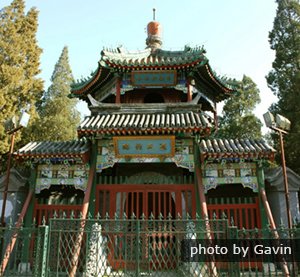
The mihrab of the Niujie Mosque, Beijing, China (北京牛街礼拜寺的米哈拉布)

Beijing Niujie MosqueBeijing Niujie Mosque

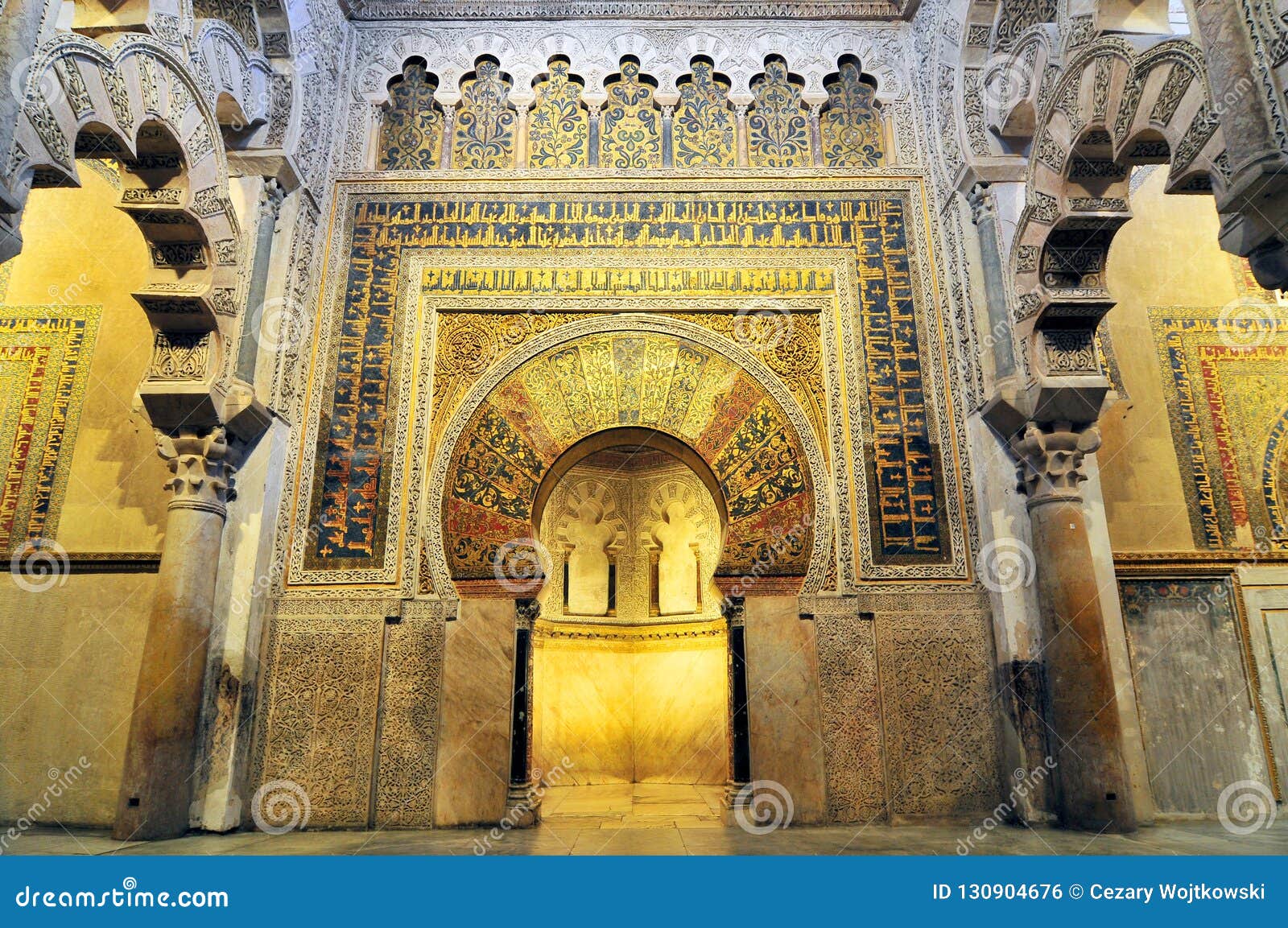
Andalucia The Moorish Mihrab of the Cordoba Mosque Mihrab Prayer Niche, La Mezquita de Cordoba, Spain.


Islamic art spans around 1400 years, covers a diverse geographic population, and is influenced by many sources. It is important to note that it is not always religious in nature.  Because of these factors scholars are often torn about the use of the phrase Islamic Art. Common characteristics include repetitive patterns, lack of figures, stylized forms based on geometry, and a decorative use of calligraphy. It has the ability to transcend time and space. These cohesive aesthetics are what define the art as Islamic, but we should be careful to recognize that individual cultures have shaped the art in the region in which it exists. (1)

The above images are of two mosques located in vastly different geographical regions. You can see the similarities in the use of geometry and repetition, or arabesque. Arches draw the viewer in and there is a pervasive quality that is hard to ignore. They both use calligraphic citation from the Koran in the decoration and there is a lack of figurative presence. However similar these mosques seem at first, there are distinct differences between the two that can be attributed to their locations. 

The top two photos are of the Niujie Mosque in Beijing China. It is the oldest mosque in Beijing and the most famous. The external architectural forms are a blend of Islamic and Chinese influence.  The structure reflects Chinese architecture in the repeated use of rectilinear forms rather than domes, and there is a distinct regional use of color and ornamentation on both the interior and exterior. It almost looks like a pagoda rather than a mosque and the use of dragons on the ornamentation gives it a distinctly Chinese vibe. (2)

Next, we fly across the globe to Spain and take a look at the Cordoba Mosque located in La Mezquita de Cordoba. This time we have a mosque with a very distinct byzantine influence. This structure has a rich and diverse history where it began as a temple, was transformed into a Church, then converted into a mosque, before being rebuilt by the Umayyads.(3)The architects made use of a number of Roman columns when rebuilding the mosque. The building is made from pieces of the Roman temple that was once occupying its place. The mihrab is an opulent masterpiece heavily influenced by Roman antiquity.

Islamic Art is not limited to a time, place, or culture. It isn't restricted to religion or architecture. We have compared two different mosques from across the globe and found that while they are different they have unifying features. They were each fashioned according to the popular architectural designs of the region, but within we found the tessellating tiles and sacred geometry that defines Islamic Art. It is truly a transcendental experience.


    Notes
    1.  "Introduction to Islamic Art," Lumen Boundless Art History, accessed September 25, 2020, https://courses.lumenlearning.com/boundless-arthistory/chapter/introduction-to-islamic-art/.
    2.  "The Niujie Mosque," China Highlights, accessed September 25, 2020, https://www.chinahighlights.com/beijing/attraction/the-niujie-mosque.htm.
    3.  "The Great Mosque of Cordoba," Khan Academy, accessed September 25, 2020, https://www.khanacademy.org/humanities/ap-art-history/early-europe-and-colonial-americas/ap-art-islamic-world-medieval/a/the-great-mosque-of-cordoba
 

Pollock's Passion

Artist Jackson Pollock dribbling sand on painting while working in his studio - Photo by Martha Holmes image source                         ...